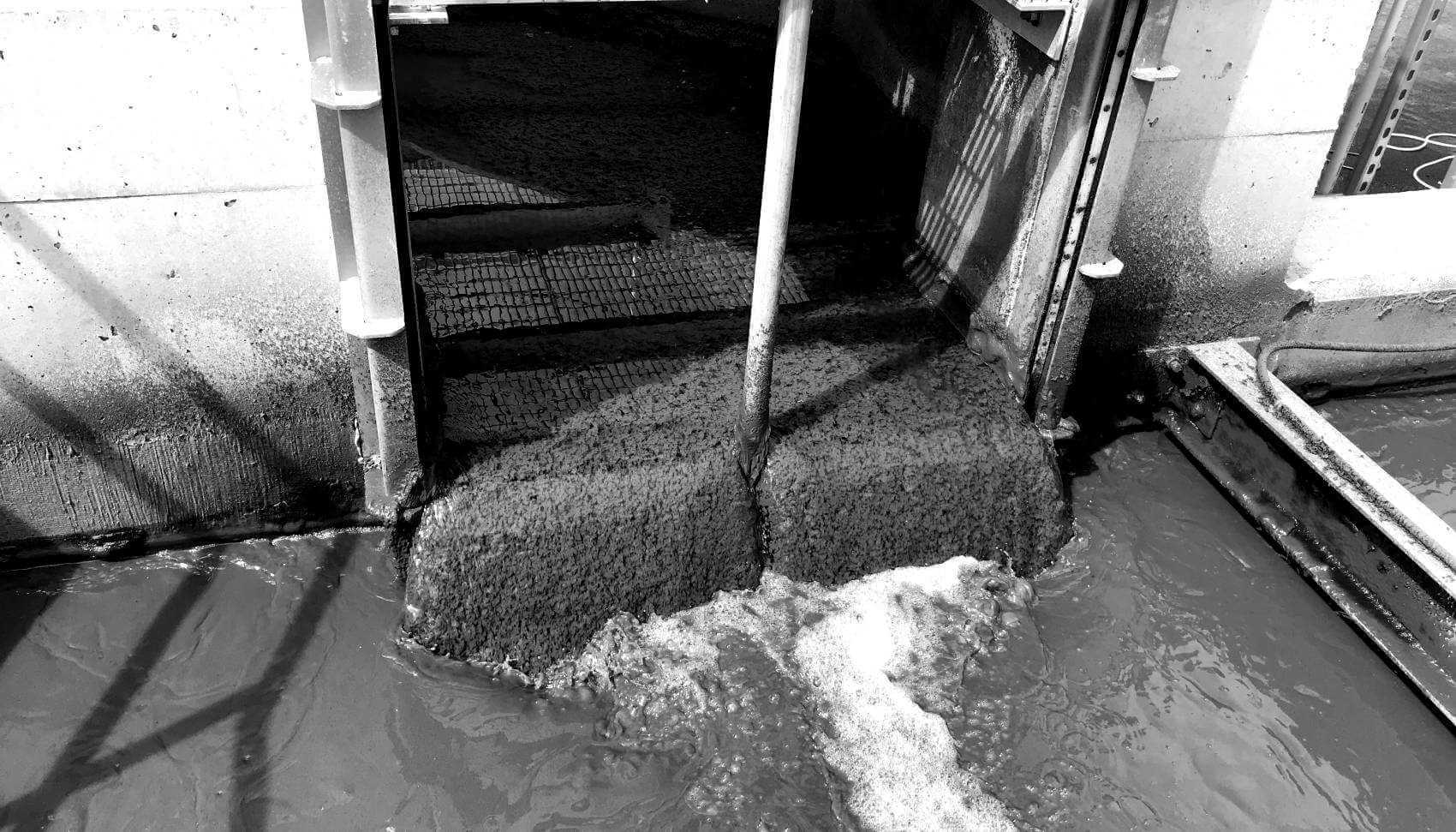
One Pipe System for Wastewater and Stormwater
In the early years of wastewater collection system development, both Halifax and Dartmouth used a "one pipe" solution, where wastewater (sewage) and stormwater (rainwater) were collected in a single pipe. This system, known as a combined sewer, still exists in some older areas of the municipality, including the Halifax Peninsula.
Today, the combined flow of wastewater and stormwater is directed to one of Halifax Water's wastewater treatment facilities for treatment before being discharged to the Halifax Harbour. However, during periods of heavy rainfall, relief points known as Combined Sewer Overflow (CSO) discharge points may release untreated wastewater to prevent overloading the wastewater system.
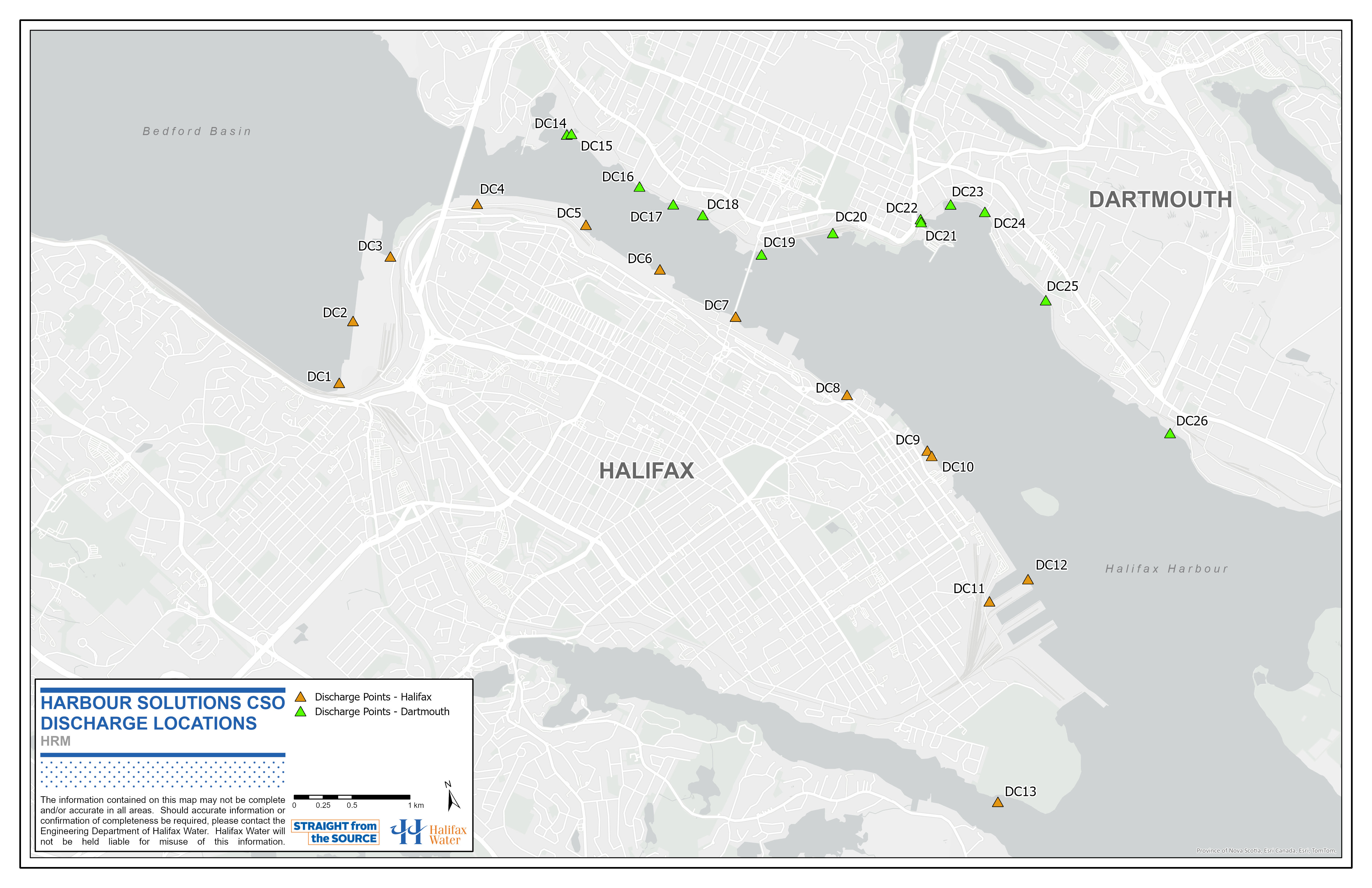
The map below identifies the CSO discharge locations that experienced an overflow during maintenance activities at the Halifax and Dartmouth Wastewater Treatment Facilities (WWTFs) in 2025. It does not represent all CSO discharge locations within Halifax Water's wastewater system.
Phase 1 - Harbour Solutions Project
By the late 1990s, there were more than 70 combined sewer outfalls discharging directly to Halifax Harbour without treatment. To better manage wastewater and help reduce impacts on the harbour, the municipality initiated the Halifax Harbour Solutions Project. This included the construction of three wastewater treatment facilities, approximately 16 kilometres of interceptor piping, and 19 overflow facilities.
When completed in 2007/08, these wastewater treatment facilities were designed to treat flows up to four times the Average Dry Weather Flow (ADWF). However, flows exceeding 4xADWF, typically during significant rainfall events, were and continue to be directed to the harbour through designated overflow points.
Phase 2 - Sewer Separation Initiatives
As the municipality has grown and infrastructure is replaced or upgraded, combined sewer systems are being separated into two-pipe systems: one for wastewater and one for rainwater/stormwater. This allows wastewater to be directed to treatment facilities, where it can be treated before being released to the harbour.
Limiting the amount of rainwater and stormwater entering these facilities reduces the volume of water requiring treatment, lowers treatment costs, and reduces the volume of water managed within the wastewater system, resulting in fewer overflow events.
Over time, these efforts will help further reduce the frequency with which flows to Halifax Water's wastewater treatment facilities exceed the ADWF.
While Sewer Separation Initiatives represent significant investments to reduce the amount of water requiring treatment at wastewater treatment facilities, there is still more work to be done.
Some homeowners have downspouts and sump pumps connected to the wastewater collection system. These connections are not permitted and should be redirected to a yard, rain garden, and/or rain barrel. Removing these connections helps reduce the amount of rainwater entering the wastewater system, which lowers the volume of water requiring treatment and helps reduce overflow events.
Before disconnecting a downspout or sump pump from the wastewater system, please visit halifaxwater.ca/downspout-disconnection-program or contact Inflow@halifaxwater.ca. Redirecting water to the ground surface should only be done where there is sufficient yard area for the water to soak in.
The Wastewater Systems Effluent Regulations (WSER) are federal regulations designed to reduce pollution from wastewater systems by establishing national minimum standards for the quality of treated effluent discharged to the environment.
Recently, the WSER were updated to include additional requirements and options for Temporary Bypass Authorizations (TBAs). These authorizations allow wastewater system operators to temporarily bypass treatment processes to carry out essential maintenance or repairs at treatment facilities or within the collection system. During a bypass, effluent may not meet the normal quality standards; however, the discharge remains regulated and authorized under specific conditions.
TBAs may involve bypasses from the final discharge point of a treatment facility or discharges from overflow points throughout the collection system. Each TBA is assigned to one of three categories based on the level of environmental risk:
- Category 1 – Low risk
- Category 2 – Medium risk
- Category 3 – High risk
Risk levels are determined by factors such as the volume and quality of the bypassed effluent, the duration of the bypass, weather conditions, and whether the discharge may affect sensitive receiving environments. Regulatory requirements vary by category, with Category 3 applications requiring environmental monitoring programs.
From April 22 to 30, 2025, Halifax Water completed a Category 3 TBA for the Halifax Wastewater Treatment Facility (WWTF). This bypass was in place to conduct several essential maintenance projects to ensure the continued operation of the system. This work was grouped together and aimed to reduce the likelihood of future bypass events. The bypass had an estimated 337,704 m³ of authorized effluent discharged to Halifax Harbour through several relief points in the system. For context, the Halifax WWTF treats approximately 31.5 million m³ of wastewater annually.
From May 5 to June 2, 2025, Halifax Water completed an additional Category 3 TBA for the Dartmouth Wastewater Treatment Facility (WWTF). This bypass was in place to conduct several essential maintenance projects to ensure the continued operation of the system. This work was grouped together and aimed to reduce the likelihood of future bypass events. The bypass had an estimated 1,310,629 m³ of authorized effluent discharged to Halifax Harbour through several relief points in the system. For context, the Dartmouth WWTF treats approximately 15.7 million m³ of wastewater annually.
As part of the Category 3 follow-up requirements, Halifax Water conducted a comprehensive monitoring program that included sampling for:
- Escherichia coli (E. coli)
- Total Suspended Solids (TSS)
- Carbonaceous Biochemical Oxygen Demand (cBOD₅)
- Un-ionized Ammonia (at 15°C)
- pH (at 15°C)
Sampling locations were selected throughout Halifax Harbour, including shoreline areas, locations near discharge points, and sites further offshore. Samples were collected at a depth of one metre, beginning two weeks before the bypass, continuing weekly throughout the bypass period, and for two weeks following its completion.
To make the monitoring data more accessible, Halifax Water developed the Halifax and Dartmouth WWTF Maintenance Harbour Sampling 2025 App. The interactive tool displays sampling locations throughout Halifax Harbour and provides access to the results collected during the Category 3 TBA monitoring program.
Please Note:
Harbour sampling was conducted; however, interpreting the data presents significant challenges due to the dynamic nature of the harbour environment. Without a clear understanding of the mixing processes, flushing patterns, seasonal variations, and the specific harbour activities occurring at the time of sampling, it is difficult to draw meaningful trends or conclusions. The harbour is subject to constant change, and while natural tidal activity will eventually flush the system, this does not provide insight into the overall water quality at any given time. This is an industrial harbour with numerous commercial activities occurring in and on it daily, and to our knowledge, there is no single entity responsible for monitoring its overall water quality.
Sampling locations situated away from discharge points showed variable results, which is expected given the influence of tides, vessel movements, and other environmental conditions that shape water quality in a complex receiving environment. By contrast, sampling locations directly at discharge points did show temporary increases during periods of active work; however, these values declined promptly once work was completed. Importantly, all results remained below the limits set out in the Wastewater System Effluent Regulations (WSER), indicating that while short term fluctuations were observed, measured concentrations did not approach regulatory thresholds.